

Table of Contents
Your HVAC System is one of the most essential components of your home, quietly working every day to maintain a comfortable and healthy indoor environment. Through hot summer afternoons and freezing winter nights, your HVAC System regulates temperature, controls humidity levels, and supports proper airflow so that every room remains livable and balanced. While it often goes unnoticed when functioning properly, it becomes immediately important the moment comfort levels shift.
Because your HVAC System operates for many hours each day, it naturally consumes a significant portion of your household energy. In fact, heating and cooling typically account for the largest share of residential utility costs. When your HVAC System is running efficiently, it delivers consistent comfort without excessive strain or inflated bills. But when inefficiencies begin to develop — whether due to aging components, clogged filters, airflow restrictions, or lack of maintenance — the system must work harder to produce the same results. That extra effort leads to higher energy consumption, increased wear and tear, and rising monthly expenses.
An inefficient HVAC System doesn’t just impact your wallet. Over time, it can shorten the lifespan of major components such as the compressor, blower motor, or heat exchanger. What might start as a minor performance issue can escalate into costly repairs or even premature system replacement. Unfortunately, many homeowners don’t recognize that their HVAC System is underperforming until energy bills spike dramatically or certain rooms stop feeling comfortable.
Early detection is crucial. Paying attention to subtle changes in performance can help you address small problems before they become major breakdowns. By understanding the warning signs of energy waste, you can take proactive steps to restore efficiency, reduce operating costs, and extend the life of your HVAC System.
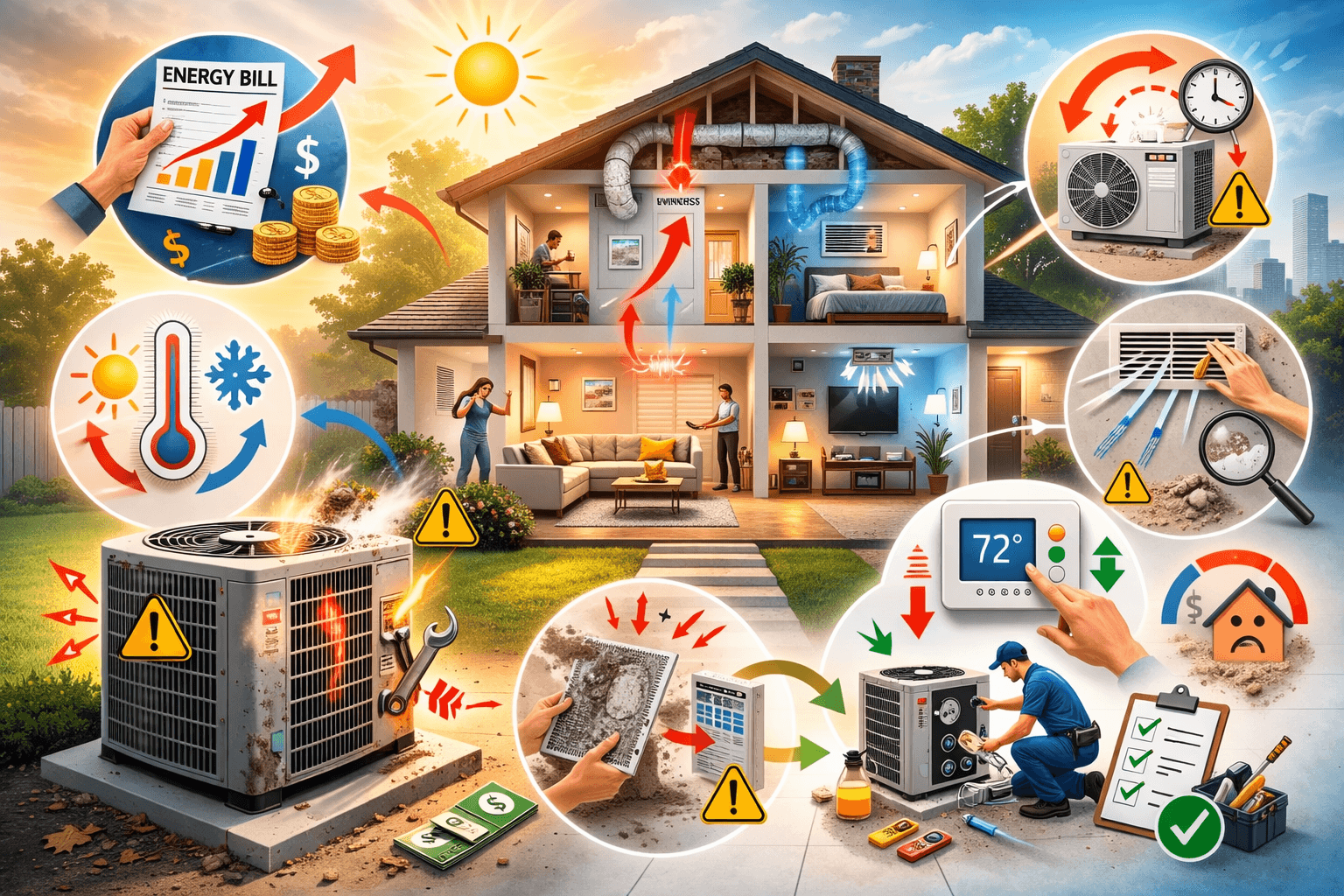
Below, you’ll find seven clear and practical signs that your HVAC System may be wasting more energy than it should — and why acting quickly can protect both your comfort and your investment.
1. Rising Energy Bills Without Increased Usage
One of the earliest and most noticeable signs that your HVAC System is wasting energy is a steady rise in your utility bills — even though your daily habits haven’t changed. If your heating and cooling costs are climbing but your thermostat settings, household occupancy, and overall usage remain consistent, your HVAC System may be operating inefficiently behind the scenes.
Your HVAC System is typically responsible for nearly half of your home’s total energy consumption. When it begins to lose efficiency, even slightly, the financial impact becomes visible fairly quickly. Small internal issues such as dirty evaporator coils, clogged air filters, low refrigerant levels, or aging mechanical components can cause the system to run longer cycles to achieve the same indoor temperature. The longer your HVAC System runs, the more electricity or fuel it consumes — and the higher your monthly bill becomes. godaddy
In many cases, the inefficiency develops gradually. You may not notice a dramatic spike right away, but instead a slow and consistent increase over several billing cycles. Because the change is subtle, homeowners often blame seasonal weather fluctuations rather than considering that their HVAC System is struggling to perform efficiently.
Another factor contributing to rising energy costs is reduced airflow. When airflow is restricted due to blocked ducts or dirty filters, your HVAC System must work harder to distribute conditioned air throughout your home. This added strain increases energy consumption while also accelerating wear and tear on critical components.
If you compare your current energy bills to the same months from the previous year and see a noticeable difference without lifestyle changes, that’s a strong indication your HVAC System may be wasting energy. Monitoring your usage patterns regularly can help you catch this problem early.
Addressing the issue promptly — whether through professional maintenance, cleaning, repairs, or system optimization — can restore your HVAC System’s efficiency, lower your energy costs, and prevent more serious mechanical failures in the future.
Learn more : 11 Steps to Reduce Energy Bills with Smart Heating Solutions
2. Uneven Heating or Cooling Throughout the Home
Another major warning sign that your HVAC System is wasting energy is inconsistent temperatures from room to room. If one area of your home feels perfectly comfortable while another feels too hot, too cold, or unusually humid, your HVAC System may not be distributing air efficiently.
A properly functioning HVAC System is designed to maintain balanced airflow and stable temperatures across your entire home. When that balance is disrupted, it usually signals an underlying issue. Common causes include leaking or poorly insulated ductwork, blocked vents, closed dampers, dirty air filters, or problems with the blower motor. Even small airflow restrictions can force your HVAC System to work longer and harder to compensate for uneven distribution.
For example, if cooled or heated air escapes through duct leaks before reaching certain rooms, your HVAC System will continue running in an attempt to satisfy the thermostat setting. This extended runtime increases energy consumption without truly improving comfort in the affected areas. Over time, the system strains itself trying to correct a problem it cannot solve without repairs. sunriseheatingandair
In multi-level homes, uneven temperatures are especially common when airflow is not properly balanced. Warm air naturally rises, and if the HVAC System isn’t calibrated correctly, upper floors may feel significantly warmer in summer and cooler in winter. Without zoning systems or airflow adjustments, the equipment wastes energy trying to regulate the entire house uniformly.
Poor insulation can also amplify the issue. If certain rooms lose conditioned air more quickly than others, your HVAC System must cycle more frequently to maintain the desired temperature. This repetitive operation increases wear on internal components and reduces overall efficiency.
Many homeowners respond to uneven temperatures by adjusting the thermostat repeatedly. However, this often worsens the problem, causing the HVAC System to run even longer and consume more power.
If you consistently notice hot and cold spots throughout your home, it’s a clear sign your HVAC System may be operating inefficiently. A professional inspection of ductwork, airflow, and system calibration can restore balance, improve comfort, and significantly reduce unnecessary energy waste.
3. Frequent Cycling (Turning On and Off Repeatedly)
A common and often overlooked sign that your HVAC System is wasting energy is frequent cycling, also known as short cycling. This occurs when your system turns on and off repeatedly in short intervals instead of running through full, efficient heating or cooling cycles. While it might seem minor, short cycling significantly reduces efficiency and increases energy costs over time.
Each time an HVAC System starts up, it requires a surge of energy to power the compressor, blower motor, and other components. When the system cycles too often, those repeated surges add up, leading to unnecessary electricity consumption. Moreover, the repeated stress from frequent starts and stops accelerates wear and tear on key components, such as the compressor, fan motors, and relays. Over time, this can shorten the lifespan of your HVAC System and result in costly repairs. godaddy
Short cycling can have several underlying causes. One of the most common is a malfunctioning thermostat. If the thermostat is incorrectly reading the temperature or poorly calibrated, it may signal the HVAC System to turn on or off too soon. Other causes include an oversized system that cools or heats your home too quickly, blocked or dirty air filters restricting airflow, low refrigerant levels, or mechanical issues like failing compressors or fan motors.
Homes with short-cycling HVAC Systems often exhibit fluctuating temperatures, inconsistent comfort, and unusual noises as the system repeatedly powers up. Residents may notice that the system seems to “kick in” too often or never seems to fully satisfy the thermostat setting. This constant operation not only wastes energy but also increases stress on the system’s components, making breakdowns more likely.
Addressing frequent cycling requires a thorough inspection of both the HVAC System and the thermostat. A qualified technician can recalibrate the thermostat, check refrigerant levels, clean or replace filters, inspect ductwork, and diagnose any mechanical issues. Fixing short cycling not only restores efficiency and reduces energy waste but also extends the life of your HVAC System, helping you avoid expensive repairs or premature replacement.
By recognizing short cycling early, homeowners can take proactive steps to optimize performance, maintain consistent comfort, and keep energy bills under control. It’s one of the clearest indicators that your HVAC System is working harder than it should and deserves immediate attention.
4. Weak or Limited Airflow
One of the most noticeable signs that your HVAC System is struggling and wasting energy is weak or limited airflow coming from your vents. When you turn on your system and barely feel air moving, or when some rooms receive noticeably less airflow than others, it’s a clear indication that your HVAC System is not operating at peak efficiency. Limited airflow doesn’t just make your home uncomfortable — it forces your system to work harder, consume more energy, and endure additional wear, all of which can shorten its lifespan.
Several factors can contribute to weak airflow. The most common culprit is a clogged or dirty air filter. Over time, filters accumulate dust, pet hair, pollen, and other debris. When the filter is blocked, air cannot flow freely through the HVAC System, making it harder for the system to distribute heated or cooled air. This obstruction forces your system to run longer and work harder to reach the desired temperature, which increases energy consumption. In addition, dirty filters can reduce indoor air quality, circulating dust and allergens throughout your home. aerosealcolorado
Another frequent cause of weak airflow is ductwork problems. Leaks, holes, or poor insulation in the duct system allow conditioned air to escape before it reaches the intended rooms. This not only reduces comfort but also means your HVAC System must compensate by operating longer, wasting both energy and money. Ducts that are too small, improperly designed, or blocked by obstructions like debris or nesting animals can also limit airflow and compromise system efficiency.
Mechanical issues within the HVAC System itself can further reduce airflow. A failing blower motor, damaged fan blades, or malfunctioning dampers can all prevent air from circulating properly. For example, if the blower motor is weak or struggling, it won’t push air through the ducts with the necessary force, leaving certain rooms too warm or too cold. Similarly, a stuck or improperly adjusted damper can divert airflow away from the areas that need it most, creating uneven temperatures and forcing the system to compensate.
Temperature inconsistencies often accompany weak airflow. You might notice that some rooms never quite reach the thermostat setting, while others become too hot or too cold. This not only affects comfort but also signals that your HVAC System is running inefficiently and consuming more energy than necessary. Homeowners often respond by raising or lowering the thermostat repeatedly, which only exacerbates energy waste and puts additional strain on the system.
Addressing limited airflow requires a combination of maintenance and inspection. Replacing air filters regularly, typically every 1–3 months depending on usage, is a simple first step that can immediately improve airflow. Cleaning vents and registers, removing obstructions, and ensuring that ducts are properly sealed and insulated are critical for restoring efficient air distribution. For more serious issues, such as a failing blower motor or damaged ductwork, professional HVAC technicians can perform repairs or recommend system upgrades to ensure optimal performance.
Ultimately, weak or limited airflow is not just a minor inconvenience; it is a strong signal that your HVAC System is wasting energy. By addressing the root causes promptly, you can restore proper airflow, improve comfort throughout your home, reduce energy costs, and extend the life of your system. Regular maintenance and careful monitoring of airflow are essential steps in keeping your HVAC System running efficiently year-round.
5. Unusual Noises or Vibrations
A properly functioning HVAC System operates quietly, providing heating or cooling without drawing attention to itself. When you begin to notice strange noises — such as grinding, squealing, rattling, or banging — it’s often a clear indicator that your HVAC System is experiencing problems and may be wasting energy. Ignoring these warning signs can lead to increased utility bills, further damage to components, and eventually costly repairs.
Different types of noises can point to different issues within the system. A grinding or squealing sound is often associated with worn or misaligned blower motors, fan belts, or bearings. When these components are not operating smoothly, the system must expend more energy to circulate air or maintain temperature, directly reducing efficiency. Rattling noises may indicate loose parts within the HVAC System, including screws, panels, or duct connections, causing vibrations that disrupt airflow and force the system to work harder. projecthvac
Banging or thumping sounds can signal more serious mechanical issues. For instance, a failing compressor in an air conditioner or heat pump can produce loud, irregular noises. Similarly, issues with the expansion valve, refrigerant lines, or other internal components can create vibrations or knocking sounds during operation. These mechanical inefficiencies force your HVAC System to consume more power than necessary to achieve the desired temperature, ultimately increasing your energy bills.
Even seemingly minor noises should not be ignored. Over time, repeated strain from misaligned or damaged components can cause permanent damage, leading to system failure. Homeowners often dismiss unusual sounds as temporary or normal wear, but in reality, these auditory cues are early warnings that your HVAC System is struggling and wasting energy.
Additionally, unusual vibrations can affect more than just the HVAC System itself. Vibrations transmitted through ductwork can loosen connections, cause air leaks, and reduce overall system efficiency. They can also contribute to uneven airflow, amplifying energy waste and discomfort throughout the home.
Addressing unusual noises and vibrations requires a thorough inspection by a qualified HVAC technician. Technicians can identify the source of the noise, tighten loose parts, replace worn components, lubricate moving parts, and ensure the system is balanced and operating smoothly. Regular maintenance, including inspection of motors, belts, and ductwork, is essential for preventing these problems and restoring efficiency.
In summary, if your HVAC System is producing sounds that seem abnormal, it’s not just an annoyance — it’s a warning sign that energy is being wasted. Prompt attention can prevent small mechanical issues from escalating into major failures, reduce energy consumption, and help your HVAC System operate at peak efficiency, ensuring consistent comfort in your home.
6. Constant Thermostat Adjustments
If you find yourself repeatedly adjusting your thermostat because your home never seems to feel comfortable, it could be a major sign that your HVAC System is wasting energy. A system operating efficiently should be able to maintain the temperature you set without constant manual intervention. When it cannot, it’s usually struggling with internal inefficiencies or underlying mechanical issues that drive up energy consumption.
Frequent thermostat adjustments are often a reaction to inconsistent temperatures. Some rooms may feel too hot while others are too cold, prompting homeowners to keep changing settings in an attempt to reach comfort. However, each adjustment triggers the HVAC System to cycle more frequently, increasing energy use and placing additional strain on components such as compressors, motors, and fans. This repetitive behavior amplifies the very inefficiency that caused discomfort in the first place.
Several factors can contribute to this issue. A malfunctioning or outdated thermostat may fail to accurately read room temperatures, causing the system to run longer or shorter than necessary. In some cases, poor placement of the thermostat — such as near a heat source, in direct sunlight, or in a drafty area — can give false readings, leading the HVAC System to operate inefficiently.
Beyond thermostat problems, the HVAC System itself may be struggling to deliver consistent heating or cooling due to clogged filters, blocked vents, dirty coils, or airflow restrictions. Even minor issues like refrigerant imbalances or aging equipment can prevent the system from maintaining the desired temperature. When the system cannot reach the thermostat setting efficiently, you instinctively adjust it more often, unknowingly contributing to energy waste.
Upgrading to a modern programmable or smart thermostat can help reduce this problem. Smart thermostats can learn your habits, adjust temperatures automatically, and optimize runtime for efficiency. Coupled with regular HVAC System maintenance — including filter replacement, duct inspection, and coil cleaning — this can restore balanced performance, reduce energy consumption, and minimize the need for constant adjustments. mcmillinair
Constant thermostat tinkering is more than just inconvenient; it’s a symptom that your HVAC System is underperforming and wasting energy. Recognizing this early and taking corrective measures ensures that your system maintains comfort efficiently, lowers energy bills, and prevents unnecessary stress on the equipment.
Learn more : The Benefits of Installing a Smart Thermostat for Your HVAC System
7. System Age and Lack of Maintenance
The age of your HVAC System and how well it has been maintained play a crucial role in its efficiency. Over time, even the most well-designed systems lose their ability to operate at peak performance. Components wear out, seals weaken, and accumulated dust or debris can impede airflow. Without regular maintenance, these issues can compound, leading to energy waste, higher utility bills, and a greater likelihood of costly breakdowns.
Most residential HVAC Systems are designed to last between 10 and 15 years, depending on usage, maintenance, and system quality. As a system approaches or exceeds this age range, its efficiency naturally declines. Older systems often use outdated technology that consumes more energy compared to modern, energy-efficient models. Components such as compressors, fans, and heat exchangers may have reduced performance, requiring the system to work harder to maintain desired temperatures. This extra effort not only wastes energy but also accelerates wear, potentially shortening the remaining lifespan of the system.
Lack of maintenance is another major contributor to inefficiency. Over time, dust, dirt, and debris accumulate in key parts of the HVAC System, including air filters, evaporator and condenser coils, blower motors, and ductwork. Clogged filters restrict airflow, while dirty coils reduce the system’s ability to transfer heat efficiently. Low refrigerant levels, worn belts, or electrical issues can also prevent the system from running optimally. Each of these problems forces your HVAC System to consume more energy just to achieve basic heating or cooling, which drives up your utility bills. projecthvac
Regular preventive maintenance can dramatically improve system efficiency. Annual or semi-annual inspections allow technicians to clean essential components, identify worn or failing parts, check refrigerant levels, and ensure proper airflow throughout the home. Even small adjustments, such as sealing duct leaks, lubricating moving parts, or replacing worn belts, can restore significant energy efficiency. In fact, routine maintenance can improve performance by up to 15%, reduce energy consumption, and extend the life of your HVAC System.
Ignoring the age of your HVAC System or skipping maintenance visits may seem convenient, but it comes with hidden costs. An older, poorly maintained system will struggle to meet comfort demands, run longer cycles, and consume more energy than necessary. By proactively servicing your HVAC System and considering upgrades when appropriate, you can prevent energy waste, maintain consistent comfort, and protect your investment in the long term.
Conclusion
Your HVAC System is one of the most important investments in your home, ensuring comfort and air quality throughout the year. However, when it begins to operate inefficiently, it can quietly waste energy, raise utility bills, and shorten the lifespan of critical components. From rising energy costs and uneven temperatures to weak airflow, unusual noises, frequent thermostat adjustments, and the natural effects of aging, there are multiple signs that indicate your HVAC System may not be performing optimally.
Recognizing these warning signs early allows you to take proactive steps — whether through routine maintenance, timely repairs, or system upgrades — to restore efficiency, reduce energy waste, and maintain consistent comfort. Regular inspections, proper filter changes, duct cleaning, and smart thermostat integration are practical measures that can significantly improve your system’s performance.
Ultimately, paying attention to your HVAC System’s performance is not just about comfort; it’s about protecting your investment, saving on energy costs, and preventing costly breakdowns. By addressing inefficiencies promptly, you ensure that your home remains comfortable, energy-efficient, and environmentally responsible for years to come.
