

Table of Contents
Introduction: Poor AC Installation and the Real Cost Behind “Cheap” Jobs
Poor AC installation is one of the most underestimated causes of high energy bills, poor comfort, and frequent HVAC breakdowns. While many homeowners believe they’re saving money by hiring the cheapest contractor or skipping professional setup, the reality is far different.
In business and technical terms, an improperly installed system can reduce energy efficiency by up to 30%, shorten the unit’s lifespan, and increase operational expenses for years.
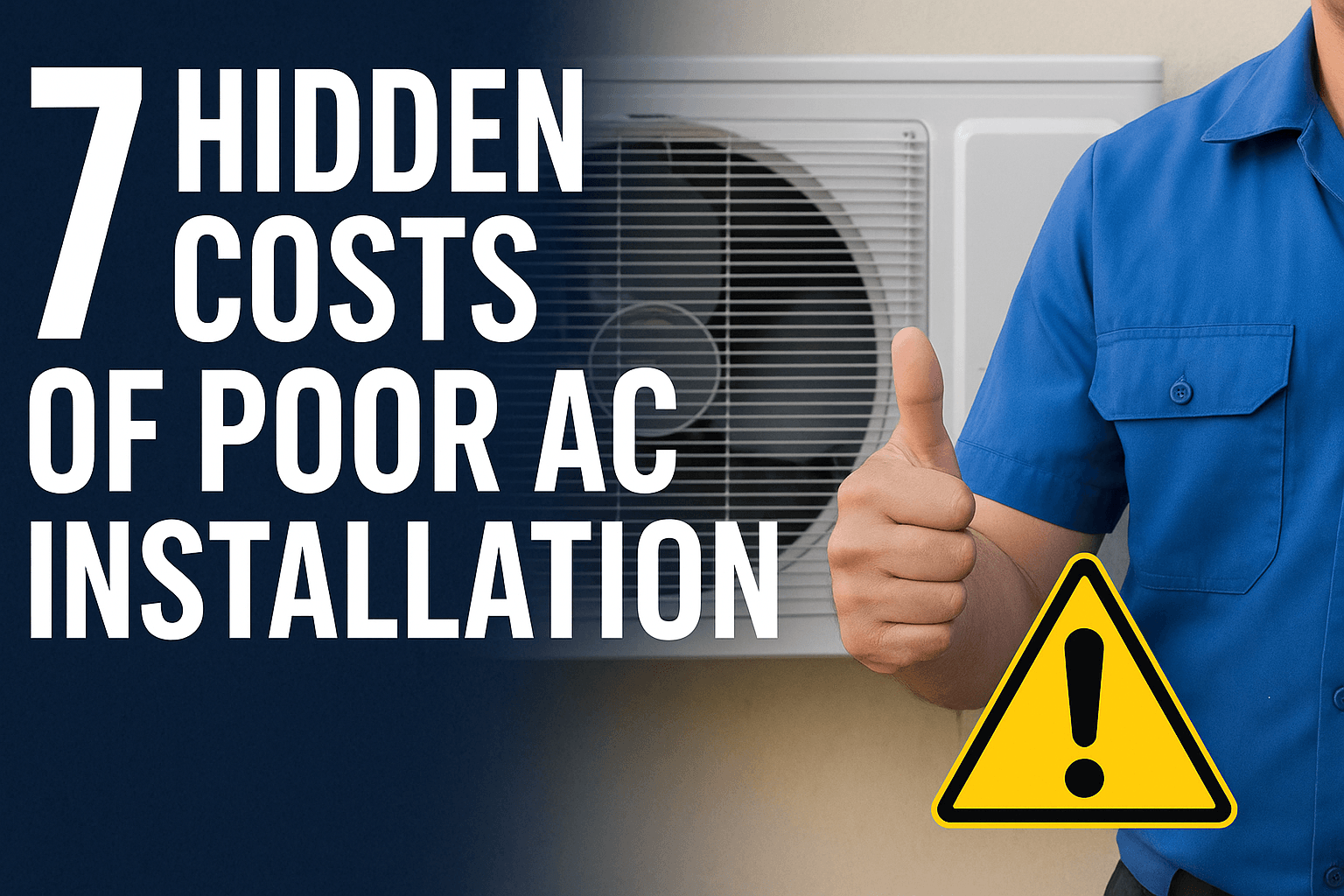
In today’s competitive real estate and mechanical contracting market, where HVAC performance directly affects property value, understanding the hidden costs of poor installation is more important than ever. This guide explores the seven most common financial and technical consequences of improper air conditioning setup — and offers actionable steps to prevent them.
👉 For detailed installation guidance, check out our article on How to Choose the Right HVAC Contractor for Your Home.
1. Reduced Energy Efficiency and Higher Operating Costs
The first and most noticeable consequence of poor AC installation is energy inefficiency. When refrigerant levels, duct alignment, or airflows are incorrectly balanced, the system must work harder to achieve target temperatures.
A miscalibrated or oversized unit may cycle too frequently, while an undersized one runs continuously. In both cases, homeowners face higher utility bills — sometimes up to 40% more energy use than properly installed systems.
Technical Breakdown:
- Incorrect refrigerant charge leads to compressor overwork.
- Poor duct sealing causes air leakage.
- Inaccurate thermostat placement creates uneven cooling zones.
How to Avoid It:
- Always request a load calculation (Manual J) before installation.
- Use licensed mechanical contractors with HVAC performance testing tools.
- Schedule regular post-installation audits using thermal imaging or airflow measurement devices.
👉 U.S. Department of Energy – Air Conditioning Efficiency Standards.
2. Shortened Equipment Lifespan
Even premium systems from brands like Trane, Carrier, or Daikin can fail prematurely if installation errors occur. Poor electrical connections, inadequate drainage, or improper refrigerant management can all accelerate wear and tear.
Business Impact:
For commercial clients or property managers, an early AC failure can disrupt tenant comfort, affect lease satisfaction, and lead to unexpected capital replacement — a major blow to ROI.
How to Avoid It:
- Conduct a commissioning test after installation.
- Verify that drain pans, condensate pumps, and electrical loads meet manufacturer specifications.
- Insist on a warranty-backed installation agreement.
👉Explore our guide on HVAC Preventive Maintenance Strategies for Businesses.
3. Poor Indoor Air Quality (IAQ)
One of the most overlooked hidden costs of poor AC installation is deteriorating indoor air quality. Improper ductwork, air leaks, or misaligned filters can allow dust, mold spores, and volatile organic compounds (VOCs) to circulate throughout the home.
Technical Insight:
- Low static pressure or excessive moisture can encourage microbial growth.
- Unbalanced airflow creates “hot and cold spots,” forcing the system to recirculate unfiltered air.
How to Avoid It:
- Install MERV-rated filters and ensure proper filter housing.
- Use UV air purifiers to prevent bacterial buildup on coils.
- Include an IAQ assessment as part of installation quality control.
👉 Resource: EPA – Guide to Indoor Air Quality.
4. Frequent Maintenance and Repair Expenses
A poorly installed air conditioning (AC) system is more than just an inconvenience — it’s a long-term financial and operational liability that can quietly drain your resources over time. What initially appears to be a budget-friendly installation can quickly evolve into a costly maintenance cycle filled with recurring repairs, inefficiencies, and premature equipment failure.
When an AC system is not installed according to professional standards, the consequences ripple across the entire system. Homeowners often begin to notice persistent refrigerant leaks, which force the system to work harder and consume more electricity. These leaks not only reduce cooling performance but also harm the environment and violate EPA handling standards.
In addition, electrical failures become common, as poorly connected wiring or undersized circuits can cause intermittent power losses, breaker trips, or even compressor burnout. Another frequent symptom is inconsistent thermostat readings, where temperature sensors fail to accurately communicate with the system, leading to uneven cooling and constant temperature fluctuations throughout the home.
Over time, these “small issues” compound into major expenses — transforming what was once considered a cost-saving decision into a financial drain. Many homeowners spend years patching up problems that could have been prevented with a proper installation from the start.
Cost Breakdown of Poor AC Installation
| Repair Type | Average Cost (USD) | Impact |
|---|---|---|
| Refrigerant Leak Repair | $300 – $800 | Reduces system efficiency and increases energy consumption |
| Compressor Replacement | $1,200 – $2,500 | Often caused by improper refrigerant charge or electrical faults |
| Duct Resealing & Rebalancing | $600 – $1,500 | Fixes air loss and uneven airflow resulting from poor ductwork design |
| Thermostat & Control Issues | $200 – $600 | Leads to uneven cooling and wasted energy |
| Premature System Replacement | $4,000 – $10,000 | Result of chronic stress on poorly installed components |
These numbers highlight that the hidden costs of poor AC installation can easily surpass the original installation fee within just a few years. The problem isn’t just mechanical — it’s systemic. Each inefficient repair cycle compounds energy waste, shortens the equipment’s lifespan, and drives up utility bills month after month.
How to Avoid These Costly Pitfalls
To prevent these long-term issues, homeowners must approach AC installation with a focus on quality, certification, and accountability rather than just price. Here’s how:
- Hire NATE-Certified Technicians:
Always choose professionals certified by North American Technician Excellence (NATE). These technicians are trained to follow industry best practices and understand the nuances of airflow, refrigerant charge, and electrical compatibility. Their expertise ensures that your system operates at peak efficiency from day one. - Ensure Compliance with ACCA Standards:
Reputable contractors adhere to Air Conditioning Contractors of America (ACCA) Manual J, S, and D standards, which guide proper load calculation, system design, and duct sizing. This ensures that your AC system is neither undersized nor oversized — both of which can cause long-term damage and energy inefficiency. - Demand a Written Installation & Service Log:
Insist on a comprehensive installation report that includes refrigerant charge levels, static pressure readings, and system calibration data. This documentation not only verifies proper setup but also becomes invaluable for future maintenance and warranty claims. - Invest in a Preventive Maintenance Agreement:
Partner with your HVAC provider for an annual or semi-annual maintenance plan that includes performance inspections, filter changes, and system recalibration. These checkups help identify early warning signs before they evolve into costly repairs. - Request a Post-Installation Energy Audit:
After the installation, an energy audit can confirm whether your system operates within expected efficiency parameters. This step provides assurance that your investment is performing as intended. - Check for Warranty Alignment:
Ensure that both labor and manufacturer warranties are properly registered and cover the key components — compressor, coils, and electronics. Improper installation can void these warranties, leaving you financially exposed. - Use Smart Monitoring Tools:
Consider integrating IoT-based monitoring systems that track system health, filter condition, and energy usage in real time. These technologies can alert homeowners and contractors to potential issues before they escalate.
The Bottom Line
Cutting corners during AC installation may save a few dollars upfront, but the hidden costs quickly outweigh any short-term savings. From refrigerant leaks to full compressor failures, the consequences of poor workmanship are both immediate and long-lasting.
A well-installed system, by contrast, pays dividends over time. It ensures optimal cooling, minimizes energy waste, and extends the life of your equipment — transforming your AC from a constant headache into a dependable comfort solution.
In the end, the smartest investment isn’t the cheapest quote — it’s the most professional installation, done right the first time.
👉 Internal Interlink: Read more in Top 7 Signs Your AC System Needs Professional Attention.
5. Voided Manufacturer Warranty
Most homeowners don’t realize that poor AC installation can void the system’s manufacturer warranty. HVAC companies like Lennox, Goodman, and Mitsubishi Electric require that installations meet specific commissioning and documentation standards.
A missing startup sheet or incorrect refrigerant pressure reading could make your warranty claim invalid.
How to Avoid It:
- Keep all installation documents, pressure test reports, and invoices.
- Register your system within the manufacturer’s time frame (typically 60 days).
- Use authorized dealers or certified installers only.
Business Tip:
Real estate investors should maintain detailed mechanical system documentation to preserve property value during resale.
👉 Resource: Lennox – Warranty and Registration Requirements.
6. Uneven Cooling and Comfort Imbalance
When ducts are poorly designed or the system is incorrectly sized, certain rooms become hot while others remain too cold. This issue, known as comfort imbalance, is one of the top homeowner complaints — and a telltale sign of poor AC installation.
Technical Root Causes:
- Undersized return vents or blocked airflow paths.
- Misplaced thermostats or unbalanced registers.
- Incorrect static pressure across duct runs.
How to Avoid It:
- Conduct zoning analysis with airflow measurement.
- Use smart thermostats for multi-zone temperature control.
- Have contractors perform a static pressure test before commissioning.
👉 Learn about Zoned HVAC Systems and How They Improve Energy Efficiency.
7. Hidden Structural Damage and Moisture Problems
Perhaps the most dangerous long-term consequence of poor installation is hidden moisture accumulation. If the condensate line is poorly designed or insulation is inadequate, condensation can seep into walls, ceilings, or attics — leading to mold, rust, and even structural decay.
Signs of Hidden Damage:
- Musty odors or peeling paint near vents.
- Water stains on ceilings around air handlers.
- Rust around refrigerant lines or coils.
How to Avoid It:
- Ensure proper drainage slope in condensate lines.
- Use closed-cell insulation on suction lines.
- Schedule a thermal imaging scan within the first six months of installation.
👉 Resource: ASHRAE – Moisture Control Design Guide.
The True ROI of Proper AC Installation
A well-installed HVAC system isn’t just about comfort — it’s a long-term investment. Proper installation can:
- Extend equipment lifespan by 5–10 years.
- Reduce energy costs by up to 35%.
- Increase home resale value through documented performance metrics.
Homeowners, builders, and property investors should view HVAC setup as a strategic asset, not a one-time expense.
Final Thoughts: Avoiding the Hidden Costs of Poor AC Installation
Poor AC installation might seem like a cost-saving shortcut, but it often becomes a silent financial burden. Every small oversight — from an unsealed duct to a misaligned refrigerant line — translates into higher bills, frequent repairs, and reduced home value.
In the era of energy-efficient smart homes, precision matters. Partnering with certified HVAC professionals ensures long-term performance, sustainability, and comfort.
👉 Internal Interlink: Don’t miss our detailed guide — Why Regular HVAC Maintenance Saves Money and Extends System Life.
Conclusion: Turning Poor AC Installation Lessons into Long-Term HVAC Success
In the world of modern HVAC technology, where systems are smarter, more efficient, and increasingly integrated into the connected home ecosystem, the cost of poor AC installation goes far beyond an uncomfortable summer afternoon. It represents a long-term technical, financial, and operational liability — one that quietly drains profits, damages property value, and undermines sustainability goals.
When we talk about “hidden costs,” we’re really describing cascading consequences — inefficiency that triggers higher energy use, strain that shortens component lifespan, and moisture issues that lead to structural or health problems. Each of these is a symptom of one root cause: installation without precision, testing, or accountability.
From a business perspective, poor AC installation affects more than homeowners. Property developers, facility managers, and HVAC service companies face real reputational and financial risks when shortcuts are taken. The long-term maintenance burden, warranty losses, and tenant complaints can erode brand trust and operational margins. For investors, especially in large residential or commercial projects, ensuring quality installation is a strategic decision — one that directly protects asset longevity and ROI.
From a technical standpoint, modern air conditioning systems are complex ecosystems. Variable-speed compressors, smart thermostats, and zoned duct systems rely on precise calibration and environmental data. A single error during installation — a refrigerant imbalance, an unsealed duct joint, or an improperly placed thermostat — can disrupt system communication and efficiency. This is why true HVAC excellence is rooted not in the equipment’s price tag, but in the quality of the installation process.
Forward-thinking homeowners and businesses are now recognizing that an AC system is not just a machine, but a data-driven asset. With IoT sensors and AI-enabled diagnostics, the next generation of HVAC technology demands installers who think like engineers, not handymen. In this evolving landscape, investing in certified mechanical contractors and performance verification tools is no longer optional — it’s the foundation of reliable climate control.
Avoiding the hidden costs of poor AC installation isn’t about spending more — it’s about spending smarter. A properly designed system, verified with airflow balancing and load calculations, can lower annual energy consumption by 25–35%. Over a 10-year span, that efficiency difference can represent thousands of dollars in savings and significantly reduced environmental impact.
Moreover, sustainability is no longer just a buzzword — it’s a business imperative. With global emphasis on green building standards and carbon reduction, professional AC installation plays a vital role in meeting LEED certifications, energy audits, and ESG compliance goals. A system that’s poorly installed today will not only cost more to operate but may also prevent your building from qualifying for future energy incentives or sustainability credits.
Ultimately, every efficient home begins with precise installation. It’s the invisible craftsmanship that determines how well your air conditioner performs, how long it lasts, and how much it costs to operate. Whether you’re a homeowner upgrading your comfort or a business investing in long-term infrastructure, the message is clear:
👉 Don’t let poor AC installation become your most expensive mistake.
Instead, work with qualified HVAC professionals, insist on post-installation performance verification, and maintain a culture of preventive maintenance rather than reactive repair. The dividends — in energy efficiency, comfort, air quality, and property value — are worth every penny invested upfront.
Because in the end, true comfort isn’t about the temperature on your thermostat — it’s about the confidence that your system is running at peak performance, protecting both your investment and your peace of mind for years to come.
