


Table of Contents
Indoor comfort is often associated with costly upgrades, full system replacements, or major renovations. However, achieving a more balanced and pleasant indoor environment doesn’t always require a large financial investment. In many situations, targeted and well-planned HVAC Adjustments can significantly enhance airflow, stabilize temperature differences between rooms, and improve overall system efficiency without replacing your equipment.
Over time, HVAC systems naturally lose some efficiency due to minor imbalances, airflow restrictions, thermostat misconfigurations, or simple maintenance neglect. These small issues can create noticeable discomfort—such as hot and cold spots, weak airflow, excessive humidity, or unexpectedly high energy bills. Instead of assuming your system is outdated or failing, making the right HVAC Adjustments can often restore performance and comfort quickly.
Strategic HVAC Adjustments focus on optimizing how your existing system operates rather than overhauling it. Simple changes like recalibrating thermostat settings, improving air circulation, sealing minor leaks, adjusting vents, or maintaining clean filters can dramatically improve how evenly conditioned air moves throughout your space. These adjustments help your system work smarter, not harder, reducing unnecessary strain while delivering more consistent results.
If you’re experiencing uneven room temperatures, a system that runs constantly, or inconsistent cooling in summer and heating in winter, it may not be a major mechanical failure. In many cases, thoughtful HVAC Adjustments can correct airflow imbalances and temperature inconsistencies almost immediately. The key is identifying small inefficiencies and correcting them systematically.
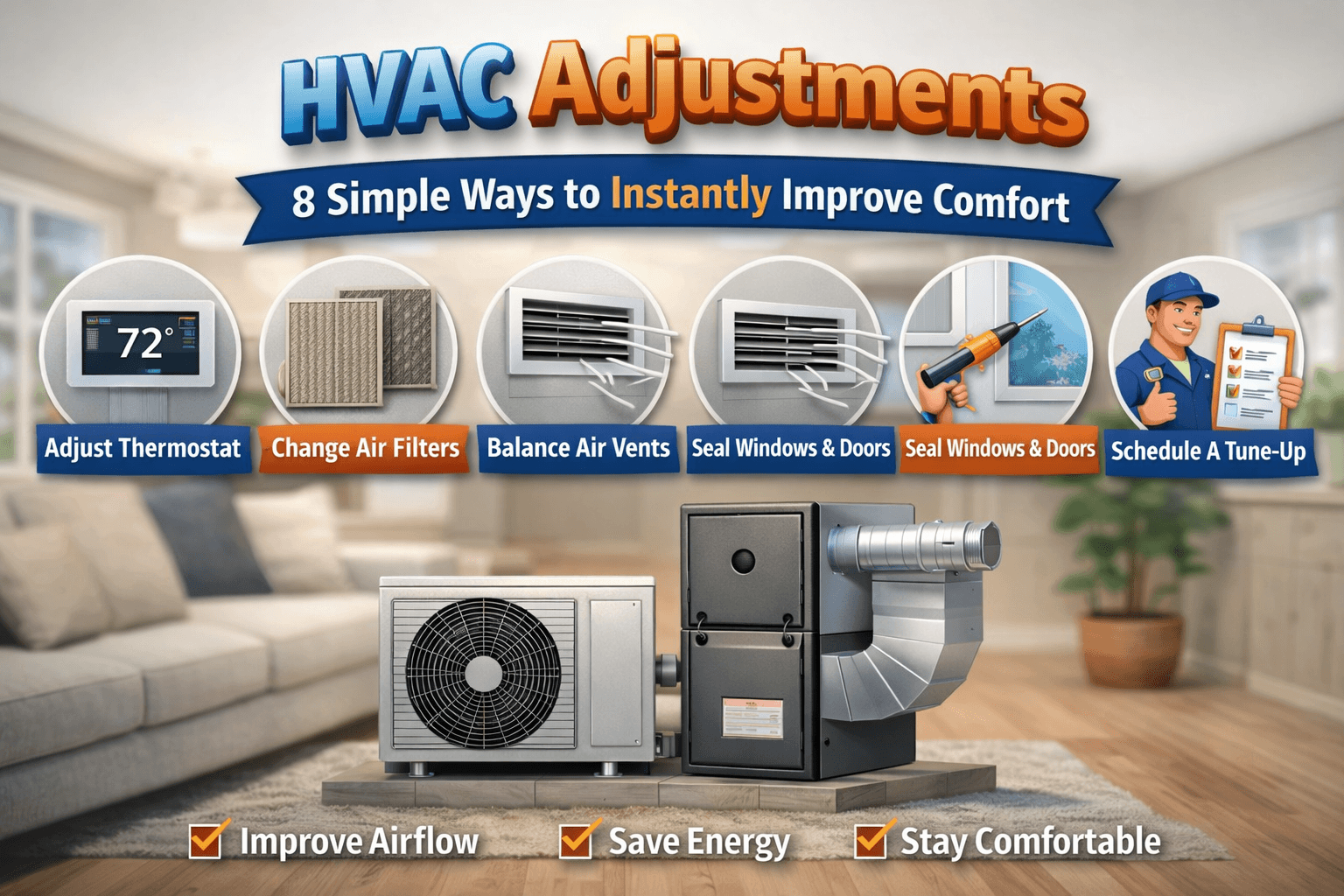
Below, you’ll discover eight simple yet highly effective HVAC Adjustments that can instantly improve comfort in your home or office. Each adjustment is practical, affordable, and designed to maximize the performance of your existing HVAC system—helping you create a more comfortable indoor environment without major expense.
1. Adjust Your Thermostat Settings Properly
One of the simplest yet most impactful HVAC Adjustments you can make is optimizing your thermostat settings. Many homeowners and office managers overlook this step, assuming that a set temperature alone is enough. However, even small changes in how your thermostat is programmed can dramatically affect indoor comfort, energy efficiency, and the overall performance of your HVAC system.
During summer months, setting your cooling temperature too low forces the system to work overtime, consuming more energy and creating unnecessary strain on components. Conversely, during winter, setting the heating too high can make certain rooms uncomfortably warm while leaving others chilly. The goal of these HVAC Adjustments is to find the optimal temperature range that maintains comfort without overworking your system. northernservicestoday
For most homes, a cooling range of 24–26°C (75–78°F) and a heating range of 20–22°C (68–72°F) provides a comfortable balance while keeping energy bills in check. If your thermostat is outdated, consider upgrading to a programmable or smart thermostat. These devices allow for dynamic HVAC Adjustments, automatically modifying temperatures based on occupancy patterns, time of day, or seasonal changes. This not only improves comfort but also reduces wasted energy by avoiding unnecessary heating or cooling when spaces are unoccupied.
Even minor thermostat recalibrations can make a noticeable difference. For example, adjusting the temperature by just 1–2 degrees or setting a gradual temperature schedule throughout the day can help your system operate more efficiently. By focusing on thermostat-based HVAC Adjustments, you take control of your indoor environment, ensuring consistent comfort, reducing energy consumption, and extending the life of your HVAC system—all without major upgrades or significant cost.
Learn more : The Benefits of Installing a Smart Thermostat for Your HVAC System
2. Change or Clean Air Filters
Another essential yet often overlooked HVAC Adjustment that can instantly improve comfort is maintaining clean air filters. Air filters are the first line of defense for your HVAC system—they trap dust, allergens, pet dander, and other airborne particles. Over time, these filters become clogged, restricting airflow and forcing your system to work harder to maintain your desired temperature. This not only decreases comfort but also increases energy consumption and accelerates wear and tear on your equipment.
Regularly changing or cleaning your air filters is a straightforward HVAC Adjustment with immediate benefits. Most experts recommend replacing standard filters every 1–3 months, although this can vary depending on the type of filter, household size, pets, and seasonal use. High-efficiency filters (with a higher MERV rating) may require more frequent monitoring to ensure they don’t overly restrict airflow.
The impact of this simple HVAC Adjustment is significant. Clean filters allow for optimal airflow, which ensures your system can evenly heat or cool every room. They also improve indoor air quality, reducing allergens and dust circulation throughout your home or office. Additionally, clean filters reduce the strain on your HVAC system, helping it run more efficiently and potentially extending its lifespan.
For households with pets, allergies, or high dust exposure, incorporating filter checks into your routine as part of seasonal HVAC Adjustments can make a noticeable difference. Even a minor lapse—like waiting too long to replace a filter—can reduce system efficiency and indoor comfort, underscoring the importance of this simple maintenance step. ogerlnewman
By prioritizing clean air filters as part of your regular HVAC Adjustments, you ensure a healthier, more comfortable environment, while also supporting your system’s long-term performance and energy efficiency.
3. Open and Balance Air Vents
Proper airflow is critical for maintaining consistent comfort throughout your home or office, and one of the simplest yet most overlooked HVAC Adjustments involves opening and balancing air vents. Even the most advanced heating and cooling system will struggle to perform efficiently if the vents are blocked, partially closed, or improperly adjusted. Over time, furniture placement, renovations, or even accidental tampering can disrupt airflow, creating hot and cold spots, reducing efficiency, and causing certain rooms to feel uncomfortable compared to others.
Balancing your air vents is a straightforward HVAC Adjustment that can yield immediate improvements in temperature distribution. Start by ensuring that all vents in high-traffic or frequently used areas are fully open. Closed or partially blocked vents in these rooms force your system to work harder, potentially overcooling or overheating other parts of your space. Similarly, vents in less-used areas can be slightly adjusted to reduce airflow where it isn’t needed, directing more conditioned air to rooms where comfort matters most.
It’s not just about whether vents are open or closed—HVAC Adjustments also involve checking for obstructions. Furniture, curtains, rugs, or shelving placed directly in front of vents can dramatically reduce airflow. Even a few inches of blockage can make a room feel stuffy or unevenly heated. By carefully inspecting and clearing these obstructions, you allow air to move freely, which helps your system maintain balanced temperatures throughout the building.
For multi-level homes or spaces with multiple zones, vent balancing becomes even more critical. Often, upper floors receive too much heat in winter or too little cooling in summer due to improper airflow. Manual adjustments to the vents, combined with strategic use of ceiling fans, can help correct these imbalances. These types of HVAC Adjustments ensure that each room receives the right amount of conditioned air, preventing some rooms from becoming too hot or too cold while others remain uncomfortable. ogerlnewman
Additionally, vent balancing as part of your routine HVAC Adjustments can improve energy efficiency. When your system doesn’t have to compensate for blocked or unbalanced airflow, it uses less energy to maintain the desired indoor temperature. Over time, this can lead to noticeable savings on energy bills, reduced wear on your equipment, and a more consistent level of comfort throughout your home or office.
Finally, consider periodic checks and minor tweaks as seasons change. Heating and cooling demands vary between summer and winter, and what worked for airflow in one season might need adjustment in the next. Treating vent optimization as an ongoing HVAC Adjustment rather than a one-time task ensures that your indoor environment remains comfortable year-round, and it allows your system to operate at peak efficiency without unnecessary strain.
By focusing on opening, clearing, and properly balancing your air vents, you make a small investment of time that can produce immediate and long-lasting improvements in indoor comfort—proving that sometimes the simplest HVAC Adjustments have the biggest impact.
4. Seal Air Leaks Around Windows and Doors
Even the most efficient HVAC system can struggle to maintain comfort if your home or office has unnoticed air leaks. Drafts around windows, doors, or other openings allow conditioned air to escape and outdoor air to enter, forcing your system to work harder and reducing overall comfort. One of the most cost-effective and immediately impactful HVAC Adjustments involves identifying and sealing these leaks. chauffage-et-climatisation.
Air leakage is more common than many homeowners realize. Over time, weatherstripping can wear out, caulking may crack, and door sweeps can become misaligned. Each small gap, when added together, can let significant amounts of heated or cooled air escape. The result is uneven temperatures, higher energy bills, and an overworked HVAC system that may struggle to reach your desired comfort levels.
To address this, start by performing a thorough inspection of your space. Check the edges of doors and windows for visible gaps, and pay attention to areas where you feel drafts on colder or hotter days. Using your hand to sense airflow or even a candle flame to detect movement can reveal leaks that aren’t immediately obvious.
Once identified, sealing these leaks is a simple HVAC Adjustment that can make a noticeable difference almost immediately. Common methods include:
- Weatherstripping: Apply adhesive-backed foam or vinyl strips around door and window frames to block gaps.
- Caulking: Use caulk to seal cracks or gaps around window frames, baseboards, or other permanent openings.
- Door Sweeps: Install or adjust door sweeps at the bottom of doors to prevent air from escaping underneath.
Sealing air leaks doesn’t just improve comfort—it enhances your HVAC system’s efficiency. When less conditioned air escapes, your system doesn’t have to work as hard to maintain the set temperature. This reduces energy consumption, lowers utility bills, and extends the life of your HVAC equipment.
Additionally, these leak-sealing HVAC Adjustments can improve indoor air quality by limiting the infiltration of dust, pollen, and outdoor pollutants. For homes in areas with extreme temperatures, sealing drafts is especially important to prevent sudden temperature swings that can compromise both comfort and energy efficiency.
Finally, consider making leak detection and sealing a part of your seasonal maintenance routine. Doors and windows can shift slightly with weather changes, and materials naturally expand or contract over time. By regularly checking and resealing where necessary, you ensure that your HVAC Adjustments continue to deliver maximum comfort and efficiency throughout the year.
In summary, sealing air leaks around windows and doors is a low-cost, high-impact HVAC Adjustment that directly improves temperature consistency, reduces energy waste, and enhances overall indoor comfort. It’s a small step that yields immediate and long-lasting results.
5. Adjust Fan Settings for Better Circulation
Another highly effective way to enhance comfort through simple HVAC Adjustments is to optimize your system’s fan settings. While many people focus primarily on heating or cooling, the way air circulates within your home or office has an equally significant impact on comfort. Improper or inconsistent air circulation can create uneven temperatures, with some rooms feeling stuffy and others drafty, even when your thermostat is set correctly. northernservicestoday
Most modern HVAC systems allow you to control the fan setting through your thermostat, typically offering “Auto” and “On” modes. Each mode serves a different purpose and can be strategically used as part of your HVAC Adjustments plan:
- Auto Mode: The fan runs only when the system is actively heating or cooling. This is energy-efficient and reduces unnecessary wear, but it may not fully distribute air throughout larger spaces or multi-story homes.
- On Mode: The fan runs continuously, circulating air even when the system isn’t actively heating or cooling. This mode improves airflow, helps maintain more consistent temperatures, and prevents stagnant air pockets.
Switching between these modes seasonally—or even periodically throughout the day—can be a simple yet powerful HVAC Adjustment. For example, running the fan on “On” for a few hours during extreme weather conditions can help evenly distribute conditioned air, reducing hot and cold spots without manually adjusting vents or thermostat settings.
Ceiling fans and other supplemental fans can further enhance air circulation. In summer, running ceiling fans in a counterclockwise direction creates a cooling breeze, allowing you to set the thermostat slightly higher without sacrificing comfort. In winter, running fans clockwise at a low speed pushes warm air that naturally rises back down into the living space, complementing your heating system. Coordinating these adjustments with your HVAC system ensures that air moves efficiently, reducing the load on your equipment and enhancing comfort.
These circulation-focused HVAC Adjustments also improve energy efficiency. By moving air more effectively, your system doesn’t have to run as long or work as hard to maintain the desired temperature. Over time, this can lower energy bills, reduce wear on components, and even extend the lifespan of your HVAC system.
Finally, consider making fan adjustments a regular part of your seasonal maintenance routine. Airflow needs change with temperature, occupancy, and humidity levels. Periodic checks and tweaks ensure your system circulates air optimally year-round, maximizing comfort and efficiency without requiring expensive upgrades. chauffage-et-climatisation.
By focusing on fan settings and circulation, you’re implementing a simple, cost-effective HVAC Adjustment that produces immediate results. Proper air movement ensures every corner of your home or office feels comfortable while supporting your system’s overall performance.
6. Clean Air Vents and Duct Openings
A simple but highly effective HVAC Adjustment that often gets overlooked is cleaning your air vents and duct openings. Over time, dust, debris, and even small obstructions can accumulate in your vents, restricting airflow and reducing the efficiency of your HVAC system. When air cannot move freely through the vents, it becomes harder to maintain consistent temperatures, and your system must work harder, leading to higher energy bills and potential wear on key components.
Cleaning vents and ducts is an essential part of any proactive HVAC Adjustments routine. Begin by inspecting all supply and return vents to ensure they are clear of dust, dirt, and obstructions. Use a vacuum cleaner with a hose attachment to remove loose debris from vent covers, grilles, and visible duct openings. Wiping down vent surfaces with a damp cloth can also help prevent dust buildup and improve indoor air quality.
In larger HVAC systems or homes with extensive ductwork, it may be worthwhile to schedule professional duct cleaning periodically. While a full cleaning is not always necessary, professional inspection can identify hidden blockages or areas where airflow may be restricted. These professional HVAC Adjustments ensure your system operates at peak efficiency and that conditioned air reaches every part of your home or office.
Regular vent and duct cleaning also has immediate comfort benefits. Removing accumulated dust allows air to flow more freely, helping eliminate hot or cold spots and improving temperature consistency throughout your space. This is particularly important in multi-story homes, where ducts on upper floors often experience airflow limitations due to bends, long runs, or partially blocked vents. northernservicestoday
Additionally, clean vents and ducts contribute to healthier indoor air. Dust, allergens, pet dander, and other airborne particles can accumulate in ductwork and re-circulate throughout your living space. By incorporating this task into your HVAC Adjustments, you not only enhance comfort but also improve indoor air quality, which is especially important for those with allergies or respiratory sensitivities.
Finally, treating vent and duct cleaning as a recurring HVAC Adjustment ensures your system maintains consistent performance over time. Seasonal checks and minor maintenance can prevent the gradual accumulation of debris, reducing strain on your HVAC system and keeping it running efficiently year-round.
By taking the time to clean your air vents and inspect duct openings, you’re making a small but highly impactful HVAC Adjustment that enhances comfort, efficiency, and overall indoor air quality—without requiring costly upgrades or complex repairs.
7. Adjust Dampers in Ductwork
For homes or offices with more complex HVAC systems, adjusting the dampers in your ductwork is a highly effective way to improve comfort and efficiency. Dampers are small, adjustable flaps located within the duct system that control the flow of air to different rooms or zones. Properly positioning these dampers is a strategic HVAC Adjustment that can instantly correct uneven heating or cooling, reduce energy waste, and ensure that every area of your space receives the right amount of conditioned air.
Many people are unaware of how much impact dampers can have on indoor comfort. Over time, dampers can shift due to vibrations, accidental adjustments, or improper initial installation. This can result in certain rooms receiving too much airflow while others remain under-conditioned. By manually adjusting the dampers, you can redirect air to areas that need it most and limit airflow to spaces that are less frequently used.
Start by identifying rooms that tend to be warmer or cooler than the rest of the building. Small, incremental adjustments to the dampers can balance airflow without affecting the overall system performance. For example, partially closing a damper leading to an unused room can increase air supply to high-traffic areas, creating more consistent temperatures. These types of targeted HVAC Adjustments are especially beneficial in multi-level homes or large office spaces where air distribution can be uneven. chauffage-et-climatisation.
Dampers also play a key role in seasonal adjustments. During winter, more warm air may be needed on upper floors, while in summer, lower floors may require increased cooling. Making damper adjustments in coordination with thermostat settings ensures that each zone receives the optimal airflow for comfort and efficiency.
Another advantage of this HVAC Adjustment is its contribution to energy savings. When air is properly distributed, the system doesn’t have to overwork to compensate for under-conditioned spaces. This reduces overall energy consumption, lowers utility bills, and minimizes wear on HVAC components.
It’s important to approach damper adjustments carefully. Small changes can have a large effect, and improper adjustments may create airflow issues elsewhere in the system. Marking positions or keeping a record of changes can help you fine-tune your settings over time, ensuring consistent results.
For those who want maximum control, some modern systems feature motorized or zone-controlled dampers. These allow for automatic HVAC Adjustments based on room occupancy, temperature sensors, or pre-programmed schedules. Even in traditional manual systems, thoughtful damper adjustments can dramatically improve comfort and system efficiency without any costly upgrades.
In summary, adjusting the dampers in your ductwork is a smart, cost-effective HVAC Adjustment that balances airflow, improves temperature consistency, enhances energy efficiency, and ensures that your entire space benefits from even, comfortable heating and cooling.
8. Schedule a Professional Tune-Up
While many HVAC Adjustments can be performed by homeowners, some require the expertise of a trained professional. Scheduling a routine professional tune-up is one of the most effective ways to ensure your system operates efficiently, safely, and comfortably year-round. A professional technician can inspect, calibrate, and fine-tune your HVAC system in ways that are difficult to achieve without specialized knowledge and tools.
During a professional tune-up, technicians typically perform several critical tasks:
- Thermostat Calibration: Ensures accurate temperature readings and optimal system performance.
- Refrigerant Level Check: Maintains proper cooling efficiency and prevents strain on components.
- Airflow Inspection: Identifies blockages, leaks, or imbalances in ducts and vents.
- Component Cleaning and Lubrication: Reduces friction, improves efficiency, and extends equipment life.
- System Safety Checks: Ensures all electrical and mechanical components operate safely.
These professional services complement the homeowner-led HVAC Adjustments you’ve already made, such as adjusting vents, cleaning filters, or sealing leaks. While DIY adjustments improve day-to-day comfort, professional tune-ups address underlying mechanical or efficiency issues that may not be immediately apparent. Regular maintenance helps prevent costly breakdowns, improves energy efficiency, and ensures your system delivers consistent heating and cooling throughout your space.chauffage-et-climatisation.
In addition, a professional inspection can identify opportunities for further HVAC Adjustments, such as optimizing airflow, recommending filter upgrades, or suggesting minor system improvements. By combining these professional insights with your own routine adjustments, you create a comprehensive strategy for maximizing comfort and system longevity.
Conclusion
Achieving optimal indoor comfort doesn’t necessarily require expensive equipment or major renovations. By implementing these eight simple yet effective HVAC Adjustments, you can dramatically improve airflow, balance temperatures, and enhance energy efficiency in your home or office. From adjusting thermostats and cleaning filters to sealing leaks, balancing vents, optimizing fan settings, and scheduling professional tune-ups, each adjustment contributes to a more comfortable, consistent, and healthy indoor environment.
The beauty of these HVAC Adjustments lies in their accessibility—they are practical, cost-effective, and capable of producing immediate results. Small, intentional changes can prevent uneven temperatures, reduce energy waste, and extend the life of your HVAC system, saving you money and stress in the long run.
Whether you tackle them yourself or enlist professional help, regular attention to these key areas ensures your HVAC system operates at peak performance. By committing to these ongoing HVAC Adjustments, you create a reliable, comfortable, and energy-efficient indoor environment that will keep your family, employees, or clients satisfied all year long.
