

Table of Contents
The Mechanical Contracting industry is undergoing one of the most significant transformations in its history, driven by a powerful convergence of advanced technologies, intelligent automation, and next-generation engineering practices. As modern buildings, industrial facilities, and large-scale infrastructure evolve into highly connected and data-driven ecosystems, the demands placed on Mechanical Contracting professionals have increased dramatically. Contractors are now expected not only to deliver precise, efficient installations but also to integrate smart systems, improve sustainability outcomes, and support long-term operational performance.
To stay competitive, leading companies in the Mechanical Contracting sector are adopting innovative digital tools, automated fabrication processes, robotics, artificial intelligence, and modular prefabrication techniques. These cutting-edge advancements are streamlining project planning, improving accuracy, accelerating timelines, and raising safety standards across the entire construction lifecycle. From intelligent building management platforms to IoT-enabled equipment and digital twins that mirror real-world performance, Mechanical Contracting is shifting toward a future where technology enhances every stage of design, installation, commissioning, and maintenance.
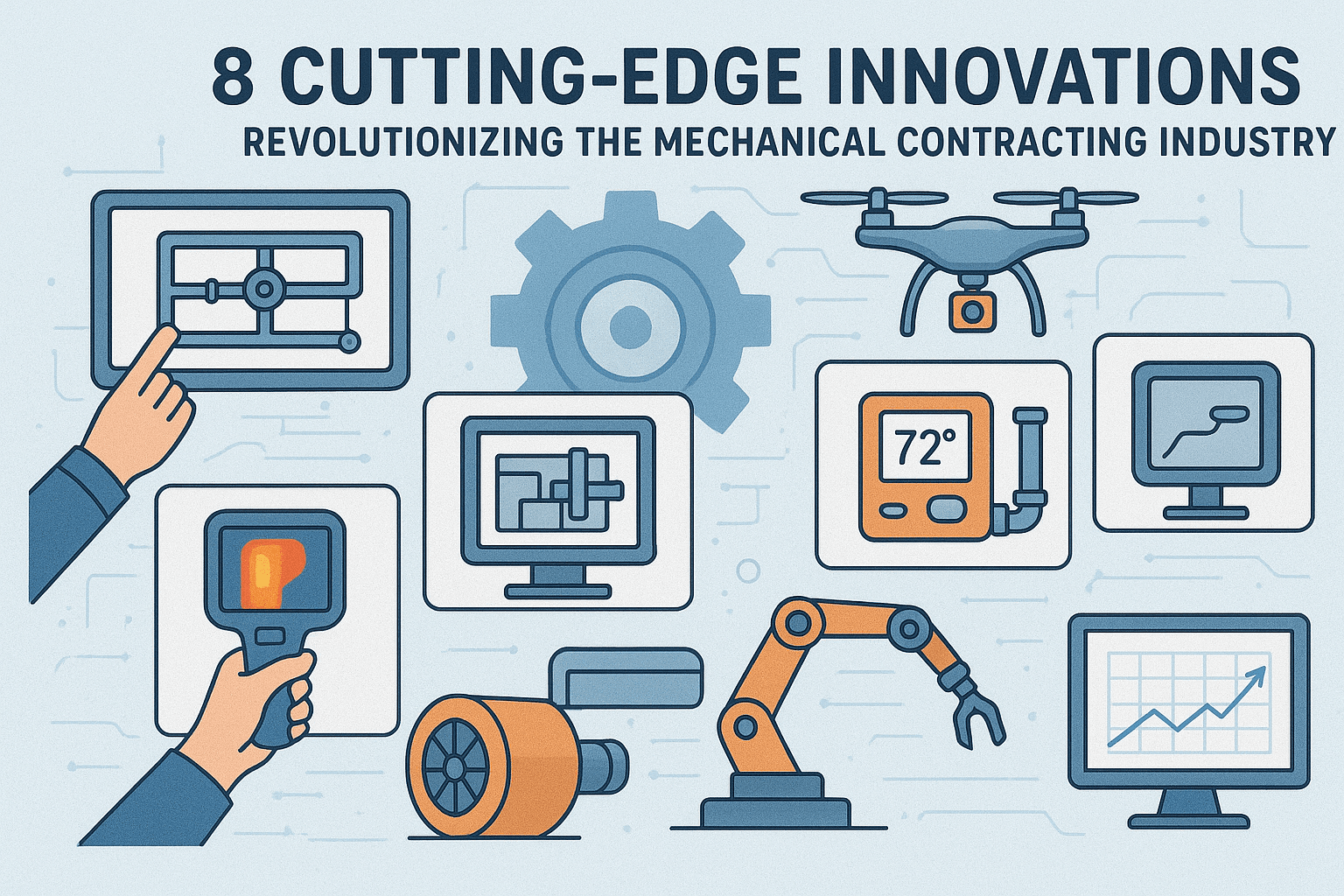
As the industry continues to evolve, these eight groundbreaking innovations are setting the foundation for a smarter, more efficient, and more resilient approach to Mechanical Contracting, ultimately reshaping how projects are delivered and how mechanical systems support the built environment for decades to come.
1. Building Information Modeling (BIM) 360 for Real-Time Collaboration
The evolution of Building Information Modeling (BIM) 360 has completely reshaped how Mechanical Contracting projects are designed, coordinated, and executed. What once served as a simple 3D modeling tool has transformed into a dynamic ecosystem for real-time collaboration. With BIM 360, Mechanical Contracting teams gain immediate access to centralized project data, live model updates, and intelligent clash detection tools that dramatically reduce design errors and field conflicts.
This cloud-driven environment allows engineers, designers, field supervisors, and subcontractors to work from the same source of truth, ensuring that every detail—from mechanical room layouts to complex piping networks—is coordinated well before installation begins. By eliminating outdated paper plans and minimizing siloed communication, BIM 360 enhances project transparency and streamlines decision-making across all phases of construction.
Why BIM 360 is transformative for Mechanical Contracting:
- Significant reduction in installation errors thanks to automated clash detection and accurate 3D coordination.
- Accelerated approval cycles, as stakeholders can review digital models instantly and provide feedback without delays.
- Stronger collaboration with architects and MEP partners, ensuring systems are integrated efficiently into the overall building design.
read more :6 Benefits of Choosing the Right Mechanical Contractor — Save Time, Energy, and Money
2. Robotics & Automated Fabrication Systems
Robotics and automation have ushered in a new standard of precision, efficiency, and workforce optimization in the Mechanical Contracting industry. In modern fabrication shops, robotic systems now handle labor-intensive and highly repetitive tasks such as pipe cutting, welding, assembling, and material handling. These machines offer unmatched accuracy and consistency, enabling contractors to manufacture critical mechanical components with minimal rework and dramatically reduced waste.
One of the biggest advantages of robotic fabrication is the ability to operate continuously—day and night—without sacrificing quality. This 24/7 capability shortens production cycles, improves scheduling reliability, and supports faster delivery of complex mechanical assemblies to the job site. Contractors can then focus skilled labor on higher-level technical tasks, such as system integration, quality assurance, and field problem-solving.
Beyond the fabrication shop, robotics are expanding their presence on job sites as well. Automated layout robots, for example, can perform precise floor marking for piping and ductwork installations in a fraction of the time required by traditional manual methods. Similarly, robotic welders and drilling systems are improving safety by reducing worker exposure to hazardous or repetitive environments.
Key benefits for Mechanical Contracting:
- Exceptional production accuracy, ensuring components fit perfectly during installation.
- Improved workforce safety, as robotics handle physically demanding or repetitive tasks.
- Faster project delivery, supported by streamlined fabrication and reduced on-site labor requirements.
As robotics continue to advance, Mechanical Contracting firms that embrace automation will gain a decisive advantage in productivity, safety performance, and overall project quality.
3. IoT-Enabled HVAC and Mechanical Systems
The rise of the Internet of Things (IoT) is transforming the capabilities of modern HVAC and mechanical systems, creating a new era of smart, connected infrastructure within the Mechanical Contracting industry. Through the integration of intelligent sensors, cloud-connected controls, and advanced monitoring platforms, contractors can now design and install mechanical systems that continuously track their own performance and adapt in real time.
These IoT-enabled systems collect a wide range of operational data—such as temperature, humidity, pressure, vibration, equipment loads, and energy consumption—providing facility owners and operators with unprecedented visibility. This continuous flow of information supports more informed decision-making and allows building systems to automatically react to environmental conditions or usage patterns.
One of the most impactful benefits of IoT in Mechanical Contracting is predictive maintenance. Instead of relying on traditional scheduled service visits, IoT sensors detect early signs of equipment wear, inefficiencies, or potential failures. Automated alerts notify technicians before problems escalate, minimizing downtime and reducing emergency repair costs.
IoT also enables remote access and diagnostics. Contractors can monitor HVAC and mechanical assets from any location, instantly identifying issues and optimizing system performance without needing to be physically on-site. This capability enhances service efficiency and strengthens long-term customer relationships.
Key advantages for Mechanical Contracting:
- Predictive maintenance, preventing system failures and maximizing equipment lifespan.
- Significant reductions in energy consumption, as systems self-adjust for optimal performance.
- Remote diagnostics and automated alerts, enabling faster response times and streamlined service operations.
By connecting mechanical assets across an entire facility, IoT empowers contractors to offer proactive service plans, optimize operational efficiency, and ensure continuous system uptime. As smart buildings become the new standard, IoT-driven HVAC and mechanical solutions will be essential for the future of Mechanical Contracting.
read more:7 Ways Mechanical Contracting Is Driving Smart and Sustainable Infrastructure
4. AI & Machine Learning for Predictive Project Planning
These advantages highlight why prefabrication has become such a powerful driver of progress in the Mechanical Contracting industry. One of the most significant benefits is the substantial time savings gained through off-site assembly. By fabricating mechanical components, pipe racks, and modular systems in a controlled environment, contractors can dramatically accelerate project delivery and maintain far more predictable scheduling. This efficiency allows teams to meet tight deadlines, reduce weather-related delays, and streamline coordination with other trades.
Another major advantage is the improved safety associated with prefabrication. Performing complex mechanical work in dedicated fabrication facilities minimizes the risks typically found on active construction sites, such as working at heights, navigating congested spaces, or operating heavy equipment near other crews. Controlled manufacturing conditions create a safer environment for workers and reduce the likelihood of accidents on-site.
Prefabrication also elevates system performance by ensuring higher consistency and quality. Components are built using advanced machinery, standardized procedures, and precision tools, resulting in mechanical systems that meet exact specifications and perform reliably once installed. Quality control teams can inspect every unit thoroughly before it ever reaches the job site, reducing rework and eliminating installation surprises.
Finally, prefabricated mechanical assemblies help minimize downtime and on-site disruption, which is especially valuable in active buildings, hospitals, schools, and industrial facilities where operations cannot be interrupted. By installing complete mechanical sections quickly and efficiently, contractors maintain project momentum and reduce disturbances for building occupants.
Collectively, these benefits demonstrate why prefabrication is becoming an essential strategy in modern Mechanical Contracting, helping companies deliver safer, faster, and more precise mechanical solutions.
Practical applications in Mechanical Contracting:
- Automated clash detection: AI tools scan BIM models to identify conflicts faster and more accurately than manual reviews.
- Cost forecasting: Predictive algorithms estimate material price fluctuations and labor needs with high accuracy.
- Labor productivity insights: AI highlights inefficiencies and suggests adjustments to optimize crew performance.
- Safety risk prediction: Computer vision and predictive analytics flag potential site hazards before they escalate.
By reducing waste, improving planning accuracy, and enabling faster decisions, AI-powered project management significantly enhances profitability and reliability on complex Mechanical Contracting projects.
5. Prefabrication & Modular Mechanical Rooms
Prefabrication has become a defining force in modern Mechanical Contracting, revolutionizing how mechanical systems are built, assembled, and installed. Instead of relying solely on labor-intensive on-site construction, contractors now fabricate entire mechanical rooms, riser systems, pipe racks, and equipment skids in controlled off-site environments. This shift not only increases precision but also minimizes the unpredictable variables associated with field installations.
In prefabrication shops, every component is manufactured under consistent conditions, using advanced machinery and standardized workflows. This ensures exceptional quality control and allows teams to assemble mechanical systems with millimeter-level accuracy. The controlled environment also enhances worker safety by eliminating the risks associated with busy job sites.
Once completed, modular mechanical rooms and assemblies are transported to the project location, where they can be installed up to 30–50% faster than traditional field-built systems. This accelerated process reduces site congestion, shortens project timelines, and improves overall coordination with other trades.
Why prefabrication is a breakthrough for Mechanical Contracting:
- Significant time savings that speed up overall project delivery and create more reliable, predictable schedules.
- Enhanced safety, as work performed in controlled fabrication environments reduces on-site risks and minimizes field exposure for crews.
- Greater consistency and quality, with every component manufactured to precise specifications and tested before arriving on-site.
- Less downtime and fewer disruptions, ensuring smoother operations in occupied buildings or tight project sites where space and time are limited.
Prefabrication empowers Mechanical Contracting firms to scale their operations, increase production capacity, and achieve unprecedented levels of efficiency and accuracy.
6. Digital Twins for Live System Monitoring
Digital twin technology is emerging as a transformative tool in the Mechanical Contracting industry, offering real-time visibility into the performance and condition of mechanical systems.ASHRAE A digital twin is a highly detailed virtual replica of a physical asset—such as a chiller plant, HVAC system, pump station, or entire mechanical room—that receives continuous data from sensors and IoT devices installed within the actual system.
This live data stream allows contractors and facility managers to monitor equipment behavior, detect anomalies, and diagnose issues with remarkable accuracy. Instead of waiting for a system failure or relying solely on scheduled maintenance cycles, digital twins support predictive maintenance, enabling teams to address problems long before they impact building operations.
Digital twins also allow users to simulate system changes in a risk-free virtual environment. Contractors can test how mechanical equipment will respond to different loads, temperatures, or operational strategies, helping optimize performance and energy efficiency.
Impact of digital twins on Mechanical Contracting:
- Rapid troubleshooting, with real-time data revealing issues instantly.
- Enhanced asset lifecycle management, extending system longevity through predictive insights.
- Improved facility management services, offering clients continuous system monitoring and performance optimization.
Digital twins are especially valuable in mission-critical settings—such as hospitals, data centers, laboratories, and high-tech facilities—where system failures are unacceptable and reliability is paramount.
7. Advanced Commissioning Tools & Smart Testing Equipment
The commissioning phase has always been one of the most critical steps in Mechanical Contracting, ensuring that mechanical systems operate exactly as designed and meet all performance, safety, and regulatory requirements. Today, a new generation of advanced commissioning tools is elevating this process to unprecedented levels of accuracy, transparency, and efficiency.
Modern devices such as wireless balancing meters, automated flow hoods, Bluetooth-enabled manometers, and cloud-connected diagnostic instruments allow technicians to collect highly precise data in real time. These tools minimize human error, speed up the verification process, and provide instant insights into system operation—all while eliminating the need for outdated manual measurements.
With cloud-based platforms, test data is securely stored, organized, and accessible to all project stakeholders. This digital workflow not only simplifies documentation but also creates a comprehensive record of system performance from day one. The result is a commissioning process that is more reliable, more transparent, and far more efficient than traditional methods.
Key advantages for Mechanical Contracting:
- Real-time reporting, enabling faster reactions to performance issues during commissioning.
- Cloud-stored test results, ensuring data accuracy, consistency, and easy access for engineers and owners.
- Significantly reduced manual data entry, minimizing errors and accelerating project closeout.
- Enhanced compliance documentation, supporting regulatory inspections and warranty requirements.
By leveraging these smart tools, Mechanical Contracting teams can ensure that HVAC, plumbing, and mechanical systems meet exact design intent, operate efficiently, and deliver long-term value for building owners.
8. Sustainable Mechanical Solutions & Low-Carbon Technologies
Sustainability is rapidly becoming the driving force behind innovation in Mechanical Contracting, especially as global regulations, environmental standards, and ESG expectations continue to rise. Contractors are now at the forefront of implementing advanced technologies that reduce energy consumption, minimize carbon emissions, and create healthier indoor environments.
High-efficiency HVAC systems, heat recovery ventilation, geothermal heat pumps, variable refrigerant flow (VRF) systems, and low-global-warming-potential (low-GWP) refrigerants are just a few of the sustainable solutions shaping the industry. These technologies not only support environmental stewardship but also deliver measurable economic benefits by reducing operational costs and extending equipment lifespan.
Mechanical Contracting firms are also adopting energy modeling tools, smart controls, and building automation systems to optimize mechanical system performance. These intelligent solutions adapt in real time to occupancy levels, weather conditions, and system demands, ensuring maximum efficiency while maintaining comfort and indoor air quality.
Environmental and operational benefits:
- Lower carbon footprint, contributing to global decarbonization goals.
- Reduced operational costs, thanks to energy-efficient mechanical systems and intelligent optimization.
- Improved indoor air quality, supporting occupant health and wellness in residential, commercial, and industrial environments.
As sustainability becomes a core priority in construction, adopting low-carbon mechanical technologies is no longer optional. It is essential for meeting modern building codes, achieving green certifications, and fulfilling the growing expectations of environmentally conscious clients.
Conclusion
The future of Mechanical Contracting is being shaped by a profound shift toward digital transformation, intelligent automation, and sustainable system design. As buildings evolve into smarter, interconnected ecosystems and project demands continue to intensify, the role of Mechanical Contracting becomes increasingly strategic and technologically driven. Companies that actively embrace advanced tools—from BIM and robotics to AI, digital twins, and prefabrication—are positioning themselves at the forefront of an industry undergoing rapid reinvention.
These innovations offer far more than operational upgrades; they fundamentally change how mechanical systems are designed, delivered, and maintained. Contractors who adopt high-efficiency solutions, predictive maintenance technologies, and environmentally responsible practices are able to reduce risk, elevate system performance, and provide tangible long-term value to clients. At the same time, intelligent workflows and automated processes help teams work safer, faster, and with greater precision.
As projects grow in scale and complexity, and as clients demand higher levels of sustainability, transparency, and reliability, the competitive landscape of Mechanical Contracting will increasingly favor companies that invest in technology and modernize their approach. Those who lead this transformation will not only improve their operational performance but also shape the next generation of infrastructure, buildings, and mechanical systems.
In an industry defined by innovation and continuous improvement, the future belongs to Mechanical Contracting firms that are ready to adapt, evolve, and embrace the technologies that are redefining the built environment.
