

Table of Contents
A reliable Mechanical System is the backbone of any residential, commercial, or industrial property. It operates quietly in the background, yet it plays a critical role in maintaining comfort, productivity, and safety. From HVAC units that regulate temperature and air quality, to plumbing networks, motors, pumps, compressors, and advanced control components, every Mechanical System works together to keep a building functioning efficiently. When properly designed and maintained, a mechanical system supports daily operations without interruption, often going unnoticed because everything simply works as expected.
However, no Mechanical System is built to last forever. Mechanical components experience constant wear and tear due to daily operation, environmental conditions, and evolving usage demands. As buildings age and technology advances, older mechanical infrastructure can quickly become inefficient and unreliable. An outdated Mechanical System may still function on the surface, but behind the scenes it can silently drain energy, increase operating costs, and place excessive strain on individual components. Over time, this hidden inefficiency reduces performance and shortens the lifespan of the entire system.
In many cases, property owners delay upgrading their Mechanical System because problems do not appear suddenly. Instead, inefficiencies develop gradually—slightly higher energy bills, more frequent service calls, inconsistent performance, or minor comfort complaints. These early warning signs are often overlooked, allowing small issues to compound into major failures. When a mechanical system finally breaks down, the result is often unexpected downtime, costly emergency repairs, and disruptions that could have been avoided with proactive planning.
Technological advancements have also changed what is possible with modern mechanical systems. Today’s Mechanical System designs emphasize energy efficiency, automation, smart monitoring, and compliance with updated safety and environmental standards. Older systems that were once considered reliable may no longer meet current performance expectations or regulatory requirements. As a result, continuing to rely on outdated mechanical equipment can place a building at a competitive disadvantage while increasing long-term risk.
Understanding when your Mechanical System needs an upgrade is essential for protecting your investment and maintaining operational stability. An upgrade is not just about replacing aging equipment—it is about improving efficiency, reducing maintenance costs, enhancing reliability, and ensuring your system can support future demands. Recognizing the warning signs early allows you to plan upgrades strategically, avoid emergencies, and maximize the return on your mechanical infrastructure.
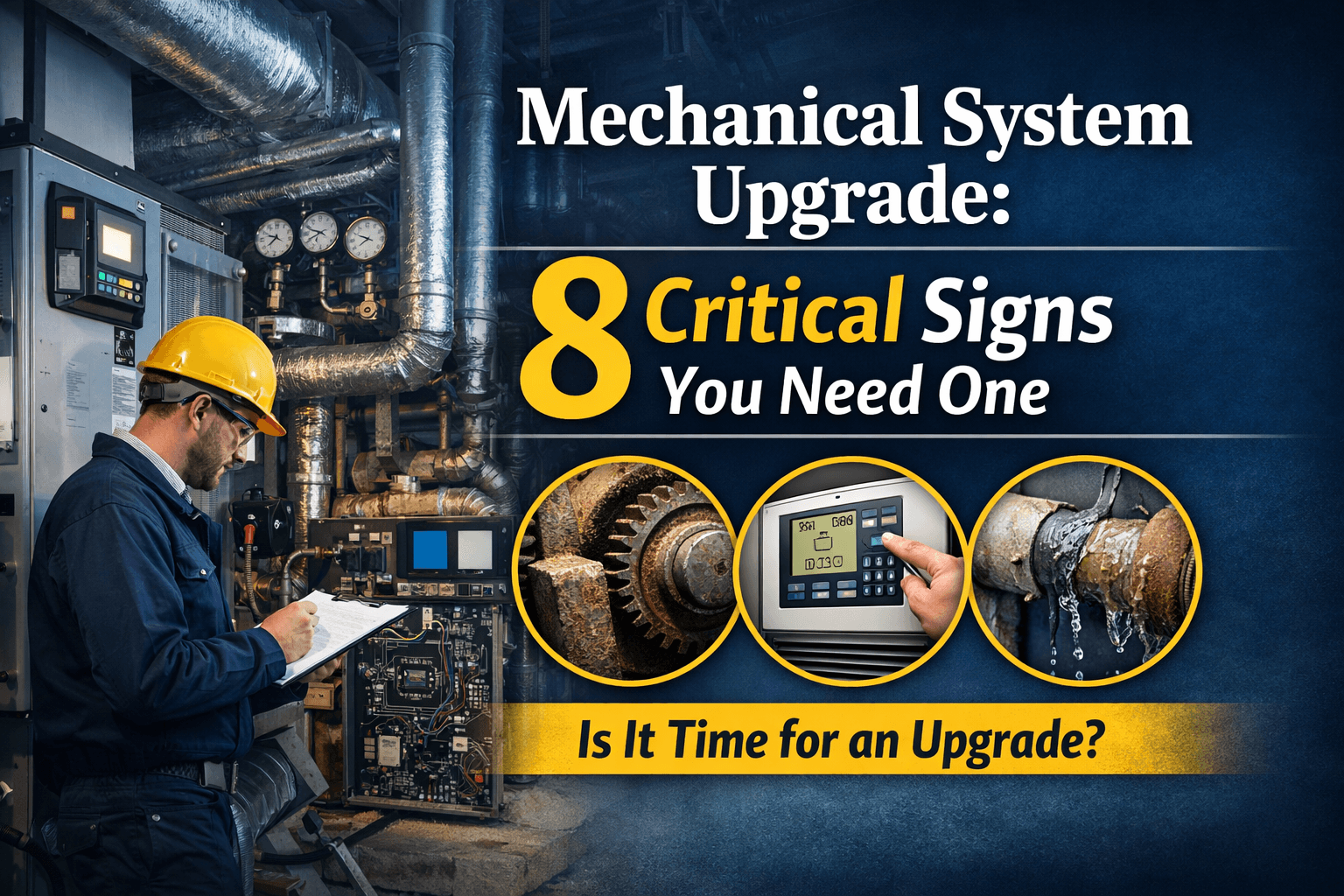
Below are 8 clear signs that indicate it’s time to upgrade your Mechanical System—before minor inefficiencies evolve into costly failures and unplanned disruptions. Energy
1. Rising Energy Bills Without Increased Usage
One of the most common and often overlooked indicators that a Mechanical System needs an upgrade is a steady increase in energy costs without a corresponding rise in usage. When energy bills climb despite stable occupancy levels, consistent operating hours, and unchanged equipment demand, the issue usually lies within the efficiency of the mechanical system itself.
As a Mechanical System ages, its components gradually lose their ability to operate at peak efficiency. Motors experience friction and wear, heat exchangers become fouled, pumps lose hydraulic efficiency, and HVAC equipment struggles to maintain setpoints. These inefficiencies force the mechanical system to consume more electricity or fuel just to deliver the same level of performance it once provided with less energy.
Outdated mechanical systems also lack modern energy-saving technologies. Older designs often rely on constant-speed motors, manual controls, and basic thermostats that cannot adapt to real-time demand. In contrast, a modern Mechanical System uses variable-speed drives, smart sensors, and automated controls to match output precisely to actual needs. Without these capabilities, older systems operate longer and harder than necessary, driving energy consumption higher each month.
Another hidden contributor to rising energy bills is poor system integration. When components of a Mechanical System no longer communicate effectively—such as HVAC units operating independently from ventilation or control systems—energy waste increases. Simultaneous heating and cooling, excessive cycling, and unnecessary runtime are common symptoms of aging mechanical infrastructure.
Ignoring these warning signs can have long-term financial consequences. Energy inefficiency not only increases utility costs but also accelerates component wear, leading to additional maintenance expenses. Upgrading your Mechanical System restores operational efficiency, reduces energy waste, and provides immediate cost savings while improving overall system reliability.
2. Frequent Breakdowns and Increasing Repair Costs
Another strong indicator that your Mechanical System needs an upgrade is the growing frequency of breakdowns and repair requests. While all mechanical systems require routine maintenance, a pattern of repeated failures signals that the system is no longer reliable. When service calls become routine rather than occasional, the underlying issue is often system-wide deterioration rather than isolated component failure. ASHRAE
As a Mechanical System ages, individual parts begin to wear out at different rates. Replacing one failing component may temporarily restore function, but it often places additional strain on other aging parts. This creates a cycle where repairs become more frequent, more expensive, and less effective over time. What initially appears to be a cost-saving decision—repairing instead of upgrading—can quickly turn into a financial burden.
Older mechanical systems were also designed with shorter lifecycles and less diagnostic capability than modern solutions. Many legacy Mechanical System designs lack real-time monitoring, making it difficult to identify issues before they escalate. As a result, failures often occur unexpectedly, leading to emergency repairs, system downtime, and operational disruptions that could have been avoided with a planned upgrade.
Repair costs also rise when replacement parts become scarce. As manufacturers discontinue older equipment models, sourcing compatible components for an aging Mechanical System becomes more difficult and expensive. Technicians may need to fabricate custom parts or retrofit incompatible components, further increasing labor costs and repair timelines.
From a long-term perspective, frequent repairs are a clear sign that your Mechanical System has reached the end of its cost-effective service life. Upgrading to a modern mechanical system reduces unplanned downtime, simplifies maintenance, and provides predictable operating costs. Instead of reacting to failures, an upgraded Mechanical System allows property owners and facility managers to regain control over reliability and performance.
3. Inconsistent Performance and Uneven Output
One of the clearest signs that a Mechanical System is struggling is inconsistent performance or uneven output. This may manifest as fluctuating temperatures, irregular airflow, variable pressure in piping systems, or uneven mechanical output across different areas of a building or facility. When your Mechanical System cannot reliably deliver consistent performance, it is a warning that efficiency and capacity are no longer aligned with current operational demands.
Several factors contribute to inconsistent performance in an aging Mechanical System. Components such as motors, pumps, valves, and fans may wear unevenly, creating imbalances in the system. For instance, an HVAC unit may struggle to distribute air evenly, resulting in hot and cold spots within a space. Similarly, a pumping system may deliver fluctuating pressure, affecting water supply or process reliability. Even small variations in system output can accumulate over time, reducing occupant comfort, operational efficiency, and equipment longevity.
Another common cause of uneven performance is outdated control technology. Legacy Mechanical System designs often rely on manual settings or basic thermostats that cannot respond dynamically to changing conditions. Modern systems, by contrast, integrate smart sensors, automated controls, and building management systems that allow precise, real-time adjustments. Without these upgrades, an older system operates on fixed parameters, leading to overperformance in some areas and underperformance in others.
The impact of inconsistent performance goes beyond minor discomfort or inconvenience. It can increase energy consumption, stress critical components, and reduce overall system lifespan. For industrial and commercial operations, inconsistent output may also disrupt processes, affect productivity, and compromise safety standards.
Upgrading your Mechanical System ensures stable, predictable performance across all areas of your property. By integrating modern controls, balancing system components, and updating outdated equipment, an upgraded mechanical system delivers uniform output, enhances efficiency, and supports long-term reliability.
4. Excessive Noise and Vibration
One of the most obvious—but often ignored—signs that your Mechanical System is struggling is the presence of unusual noises or vibrations during operation. Grinding, rattling, banging, or humming sounds can indicate that critical components are worn, misaligned, or operating under excessive stress. Even vibrations that seem minor can signal underlying mechanical issues that, if left unaddressed, may escalate into complete system failure.
Excessive noise is not merely a nuisance; it is often a symptom of mechanical imbalance or fatigue. Motors may have worn bearings, fans or pumps may be misaligned, or structural components may be loose or degraded. In an older Mechanical System, these issues tend to compound over time, creating additional strain on connected components and accelerating overall wear. Left untreated, this can lead to costly emergency repairs and unplanned downtime, which is particularly disruptive in commercial or industrial operations.
Modern Mechanical Systems are engineered with precision and noise-reduction technology in mind. Features such as vibration-dampening mounts, balanced rotating components, and advanced motor design help reduce operational noise while improving efficiency. Upgrading your mechanical system not only restores smooth and quiet operation but also enhances the longevity of the equipment and creates a safer, more comfortable environment for occupants.
Furthermore, persistent noise and vibration often indicate energy inefficiency. Components under stress require more power to perform their tasks, which can indirectly contribute to rising energy costs. By addressing these warning signs through a system upgrade, you can improve operational efficiency, reduce energy consumption, and prevent small issues from turning into major mechanical failures.
In short, if your Mechanical System is making noises or vibrating more than usual, it’s more than an annoyance—it’s a signal that your system is past its prime and an upgrade is necessary to maintain reliable, efficient, and safe operation.iccsafe
5. Difficulty Finding Replacement Parts
As a Mechanical System ages, one of the most practical signs that it needs an upgrade is the growing difficulty in sourcing replacement parts. Over time, manufacturers phase out older models and stop producing components for legacy systems. This makes repairs increasingly complex, time-consuming, and expensive. When critical parts are no longer readily available, even minor issues can lead to significant operational disruptions.
Maintaining an outdated Mechanical System often means relying on specialty suppliers, custom-fabricated components, or retrofit solutions that may not perform as well as the original equipment. Each of these alternatives adds cost, increases downtime, and complicates routine maintenance. In industrial or commercial settings, where downtime directly impacts productivity, the consequences can be severe.
Upgrading to a modern Mechanical System addresses these challenges by ensuring that all components are standardized, readily available, and backed by manufacturer support. Modern systems are designed with replaceable, modular components that simplify maintenance and reduce the risk of prolonged outages.
Moreover, a new Mechanical System upgrade often comes with warranties, service agreements, and access to manufacturer support networks, providing peace of mind that older systems cannot offer. Investing in an upgrade ensures reliability, minimizes future maintenance headaches, and improves long-term operational efficiency.
In essence, if replacement parts for your Mechanical System are becoming scarce or costly, it’s a clear signal that it’s time to consider an upgrade before maintenance challenges escalate into expensive emergencies.
6. Outdated Controls and Lack of Automation
Another major indicator that your Mechanical System may need an upgrade is outdated controls or a lack of automation. Older mechanical systems often rely on manual switches, basic thermostats, or simple timers to regulate operation. While these controls may have been sufficient when the system was first installed, they cannot adapt to the dynamic demands of modern buildings, leaving the system inefficient and prone to overwork.
Without advanced controls, a Mechanical System may operate at full capacity even when full output is unnecessary, wasting energy and putting unnecessary strain on components. Conversely, it may underperform during peak demand, creating discomfort, process interruptions, or operational inefficiencies. Inconsistent control and lack of automation reduce overall system reliability and can accelerate wear on critical components. FacilitiesNet
Modern Mechanical Systems address these challenges by integrating smart controls, automated monitoring, and building management system (BMS) connectivity. Advanced sensors can detect real-time conditions—such as temperature, pressure, or airflow—and automatically adjust system performance to maintain optimal efficiency. Automation also allows predictive maintenance alerts, reducing unexpected downtime and enabling proactive component replacement.
By upgrading your Mechanical System to include these modern controls, you gain several advantages: improved energy efficiency, reduced maintenance costs, longer equipment lifespan, and consistent performance under varying conditions. In addition, automated systems provide valuable operational data, helping facility managers make informed decisions to optimize system use and energy consumption.
If your Mechanical System still relies on outdated manual controls, it is a strong signal that an upgrade is overdue. Embracing modern automation ensures your system operates efficiently, reliably, and safely while future-proofing your facility against evolving demands.
7. Failure to Meet Current Codes and Safety Standards
Another critical sign that your Mechanical System needs an upgrade is its failure to meet current codes and safety standards. Building codes, environmental regulations, and safety requirements evolve over time to improve energy efficiency, reduce emissions, and protect occupants. An older Mechanical System may have been compliant when installed but can quickly fall out of alignment with modern regulations, creating legal and operational risks.
Non-compliance can manifest in several ways. For example, older HVAC systems may not meet updated ventilation or air quality standards, piping systems may not comply with current pressure or material regulations, and electrical components may lack modern safety protections. Operating a Mechanical System that does not meet current standards can lead to fines, increased insurance costs, or even legal liability in the event of accidents or failures.
Upgrading your Mechanical System ensures that all components meet or exceed current regulatory requirements. Modern mechanical systems are designed with safety, efficiency, and sustainability in mind. They often include advanced ventilation controls, filtration systems, energy-efficient motors, and emergency shutdown features that enhance both operational reliability and occupant safety.
Beyond compliance, a system upgrade also protects your investment by reducing risk and ensuring long-term reliability. Facilities with outdated Mechanical Systems are more vulnerable to unplanned failures, which can result in costly downtime and repairs. A modern, code-compliant system not only safeguards occupants but also improves energy efficiency, reduces operational costs, and enhances overall system performance.
In short, if your Mechanical System is no longer aligned with current codes or safety standards, it’s more than just a regulatory concern—it’s a clear signal that an upgrade is necessary to maintain safe, efficient, and reliable operations.
8. Your Building or Operation Has Outgrown the System
Finally, a clear sign that your Mechanical System needs an upgrade is when your building or operation has outgrown its capacity. Over time, changes in occupancy, equipment, or operational requirements can place demands on a mechanical system that exceed its original design. An undersized or overworked system struggles to maintain consistent performance, efficiency, and reliability, creating stress on components and increasing the risk of failure.
For example, a commercial building that has added new office spaces, additional machinery, or expanded production lines may require increased airflow, higher heating or cooling loads, or greater water and energy supply. Similarly, residential properties that have undergone renovations or added high-demand appliances can experience uneven heating, cooling, or water pressure if the existing Mechanical System cannot meet the new requirements.
When a Mechanical System is pushed beyond its capacity, it operates under strain, often cycling excessively, consuming more energy, and requiring more frequent maintenance. These inefficiencies not only increase operational costs but also accelerate wear and reduce the system’s lifespan.
Upgrading to a modern, properly sized Mechanical System ensures that your facility can handle current demands efficiently while also providing flexibility for future growth. Modern systems are designed with scalability in mind, allowing components to be easily adjusted, expanded, or optimized as operational needs evolve. This proactive approach prevents costly emergency upgrades, reduces energy waste, and ensures reliable performance for years to come.
In short, if your building or operation has expanded beyond the capabilities of your existing Mechanical System, it is time to invest in an upgrade that meets your current needs and prepares you for future growth.
Conclusion
Your Mechanical System is one of the most critical components of any building, whether residential, commercial, or industrial. It ensures comfort, safety, efficiency, and reliable operation. However, as systems age, demands change, and technology evolves, even the most robust mechanical systems can become inefficient, unreliable, or non-compliant with modern standards.
Recognizing the warning signs early—rising energy bills, frequent breakdowns, inconsistent performance, excessive noise, difficulty sourcing parts, outdated controls, non-compliance with safety codes, or insufficient capacity—can save significant time, money, and operational disruption. Each of these indicators signals that your Mechanical System may be past its prime and in need of a strategic upgrade.
Upgrading your Mechanical System is more than simply replacing old equipment. It is an investment in efficiency, reliability, and long-term performance. Modern systems offer advanced controls, automation, energy efficiency, code compliance, scalability, and reduced maintenance costs. By proactively addressing these signs, you can prevent unexpected failures, optimize operational performance, and ensure that your mechanical system continues to support your property for years to come.
In today’s fast-paced and energy-conscious environment, maintaining an outdated Mechanical System is not only costly but also risky. Taking action early through system upgrades allows you to maximize efficiency, reduce energy waste, extend equipment lifespan, and provide safe, comfortable conditions for occupants or operations. Ultimately, a well-maintained and modern Mechanical System is a foundation for sustainable performance, long-term savings, and peace of mind.
Learn more : 6 Benefits of Choosing the Right Mechanical Contractor — Save Time, Energy, and Money
